

CellCube battery storage increases the use of on-site electricity and supports process reliability at the Bochum site
Energy supply is a key component of the Nagel-Group’s operational infrastructure. The site in Bochum illustrates how this is reflected in specific measures on the ground. In order to make greater use of the electricity generated by the rooftop photovoltaic system in the Ruhr region, the local infrastructure has been expanded to include a key component: vanadium.
Since 2020, one of the larger rooftop solar installations in the Ruhr region has been in place on the branch’s roofs (September 2026). Around 8,000 modules cover an area of 13,000 square metres. For comparison, the lawn of Bochum’s Ruhrstadion is just over half that size at 7,000 square metres. The plant produces up to 2 million kilowatt-hours per year.
However, only part of this energy has been used on site so far. While the cooling system and the battery-electric trucks were able to draw on the energy when the sun was shining, at night or during peak loads, the site continued to rely heavily on external sources. At the same time, when weather conditions were ideal, more electricity was produced than could be consumed. The average self-consumption rate (2025) was around 60 per cent, with the rest having to be fed into the grid.
The CellCube redox flow battery storage system installed at the Bochum site is set to increase the on-site consumption of solar power generated there, in combination with the new energy management system.
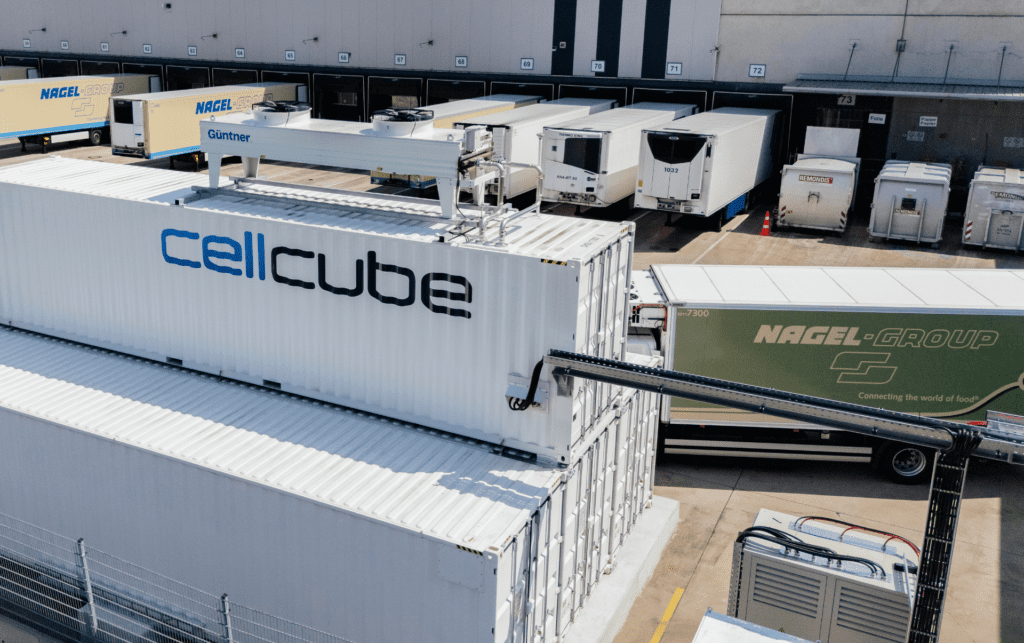
The CellCube redox flow battery storage system installed at the Bochum site.
Focus on owner-occupation and energy management
In order to increase the use of on-site solar power, a battery storage system was to be installed at the branch. A particular technical requirement of the project was the demand-based control of charging and discharging processes whilst logistics operations were ongoing. Following extensive research and in-depth discussions, a suitable partner for the project was found in the form of an Austrian supplier.
The company CellCube Energy Storage has been working on a new, powerful energy storage solution just outside Vienna for more than 25 years. The function of these so-called redox flow batteries is easy to explain: electrolytes are stored in two separate tanks as a storage medium. They are pumped through a cell in separate circuits, where the stored energy is then provided as electrical energy as needed. ‘The vanadium electrolyte we use is recycled from by-products of the steel industry. It is non-flammable, reusable and does not contain any rare earths, which represents a significant environmental advantage over conventional battery systems,’ says Christoph Stelzer, COO of CellCube Energy Storage GmbH, explaining the benefits of vanadium flow technology.
There are other important advantages to this setup. The storage capacity depends on the size of the tanks, while the performance is determined by the size of the cell. This means that energy and performance requirements can be scaled independently of each other and precisely adapted to the respective requirements. The energy can be stored flexibly and provided in a targeted manner over a discharge period of 4 to more than 24 hours. With a lifespan of around 30 years and more than 30,000 charging cycles, the storage system is ideal for daily use at the Nagel-Group site in Bochum.
Forward planning
Since July 2025, a redox flow battery has been part of the energy infrastructure at the Bochum site. The aim is to increase the proportion of locally generated solar power used for the company’s own consumption and to manage peak loads in a targeted manner. One challenge remained: “With the battery storage system, we want to manage electricity intake and output even more efficiently,” explains Sven Budde, Technical Manager at the Nagel-Group’s Bochum site. “The sun doesn’t always shine over the Ruhr region, and we experience significant fluctuations in demand at times. To prevent peaks, we need to be able to plan ahead,” Budde continues. Together with CellCube and Solar-E-Technik Hamm GmbH, an application was therefore developed designed to enable precisely that.
After an intensive development phase, the new energy management system underwent its first tests in December 2025. And after just a short period of fine-tuning, it became clear that the project was a complete success. Thanks to the newly gained predictability, the engineers achieved their declared goal of 100 per cent self-consumption of the green electricity produced on site. This is a major success for the environment, which also benefits the company. Another important aspect is that in extreme cases, the storage facility can function as an emergency generator and compensate for power failures. A safety net that can be invaluable in food logistics.
Lessons learnt from the project
“Logistics is an energy-intensive sector. Using electricity responsibly is not only of great environmental importance, but also of significant business importance. With CellCube’s redox flow battery storage system, the Nagel-Group is enhancing the energy infrastructure at its Bochum site,” explains André Pleines, Executive Director of Real Estate at the Nagel-Group.
It is therefore logical that the successful completion of this project will lead to further measures. On the one hand, the PV roof system in Bochum is currently being expanded, which will increase the maximum output by another 1,200 kW. On the other hand, the successful model from the Ruhr area is also to be implemented at other locations in the future. The starting signal for projects at the branches in Hamburg and Schweitenkirchen has already been given.
updated on 22 September 2026