

Refrigeration technology in food logistics: key technology for quality and efficiency in the industry
Whether frozen pizza, yogurt, or salmon: many products in supermarkets must be kept refrigerated at all times. Even the slightest temperature fluctuations can lead to spoilage or quality loss. Using state-of-the-art refrigeration technology, the Nagel-Group ensures that millions of food items reach the shelves intact every day, from the production site to the store.

A stable and reliable refrigeration system is crucial for product quality and security of supply.
Challenges of modern refrigeration technology
With around 130 warehouses and transshipment centers, the Nagel-Group operates some of the largest refrigerators in Europe. In total, the company has around 1.8 million pallet spaces for dry, fresh, and frozen goods. State-of-the-art refrigeration systems form the backbone of this logistics operation. They maintain a constant temperature in the Nagel-Group’s warehouses, ensuring the quality of the stored products.
Refrigeration systems can account for a significant proportion of a site’s energy requirements. Added to this are increasing requirements due to longer supply chains, higher quality and hygiene standards, and strict legal requirements, such as the EU F-Gas Regulation* to reduce climate-damaging refrigerants.
“Our investments in modern refrigeration technology are an integral part of our comprehensive site infrastructure modernization project,” says André Pleines, Executive Director Real Estate. “Our goal is to make our sites efficient and future-proof.”

Multi-temp system in Nuremberg
Refrigerant ammonia (R717)
As part of this modernisation, we are using the refrigerant ammonia (R717). Ammonia occurs naturally as a chemical substance and has neither ozone-depleting potential (ODP = 0) nor direct global warming potential (GWP = 0). Recent construction projects, such as the Multi-Temp facility in Schweitenkirchen, the automated high-bay warehouse in Nuremberg and the new logistics complex in Hamburg, have been operated using this refrigerant from the outset. At the same time, existing facilities are being modernised.
Digitalization, AI, and automation
In addition to the conversion of refrigerants, digital control of the systems is also becoming increasingly important. To make processes more transparent, the Nagel-Group relies on digital control systems and IoT monitoring (we reported on this on 23 April 2025 in our newsroom). This enables temperature trends to be digitally recorded and documented. Deviations can be detected at an early stage and the affected processes can be examined in a targeted manner. The data collected can also help to analyse energy consumption and identify potential savings.
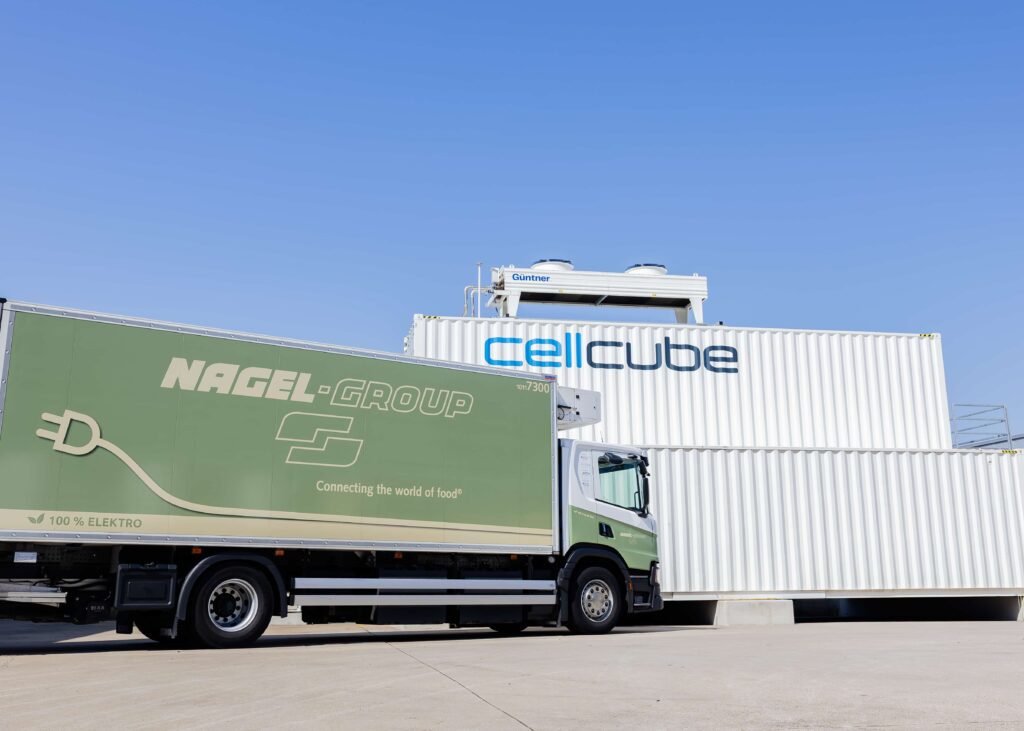
An innovative battery storage system from Austrian manufacturer CellCube is in operation at the Bochum site.
Energy efficiency through self-sufficiency
Smart energy management is required to meet the high energy demands of refrigeration systems. In Germany, the Nagel-Group has around 45,000 m² of photovoltaic space at its disposal. The use of photovoltaic systems in combination with modern battery storage systems not only generates electricity but also stores it. This is the case, for example, at the Bochum site, where a battery storage system from the Austrian manufacturer CellCube with a storage capacity of 2.5 MWh and a maximum power output of 500 kW has recently been put into operation. At night or on days with low solar radiation, the storage system provides surplus energy for cooling.
Complete cold chain
Refrigeration technology is a key component of food logistics. Reliable refrigeration systems help to ensure that the required temperature ranges are maintained, thereby safeguarding the quality of the products being stored and transported.
In addition to its refrigeration technology, the Nagel Group is also continuing to develop its energy supply and vehicle fleet. Electric tractor units and refrigerated semi-trailers are already part of the existing fleet. Further measures are being assessed and implemented, taking into account technical, economic and regulatory conditions.
* F-gas-Regulation
The bans and restrictions imposed by the European F-Gas Regulation are intended to reduce emissions of greenhouse-effect fluorinated refrigerants (F-gases).
updated on 22 September 2026